I decided that this month was going to be a new adventure for me: saving money.
Those of you that know me already know that I'm pretty good at this, but I had a few reasons to persue this adventure:
1. I have students that are on vacation, meaning 6 hours less of classes per week for a month.
2. I want to meet my savings goals in order to be able to buy a new laptop, prescription sunglasses, travel to Colombia, and pay back college loans and the very generous bank of Dad.
3. San Pedro was a great trip, but now it's time to be frugal again for a month or two.
Add to this that my gym membership has expired and I don't want to spend money on a new one, and you have a perfect recipe for finding ways to save money.
For the past few weekends I've gone to the La Vega market. For those of you that don't remember, it's a huge market that sells fruits, veggies, meat, fish, and even housewares at prices cheaper than what you'd pay in a supermarket. I remember learning that back when I first moved here, but since moving to ñuñoa it has seemed too far away to make the trip worth it. I´m really glad I started going again. Here are some prices I pay for things there:
a kilo of bananas 450 pesos
a kilo of tomatoes 800 pesos
a kilo of strawberries 700 pesos
4 porkchops 1350 pesos
a half kilo of whole grain cereal 1200 pesos
a quarter kilo of ham lunchmeat 550 pesos
a kilo of frozen veggies for 990 pesos
For those of you who aren't familiar with kilos and pesos, a kilo is about 2.2 pounds, and about 500 pesos is a dollar. Your money really goes far at La Vega, and now it makes sense to me. At a market like that, they don't have to pay for packaging, maintainance costs, cleaning, or any of the other costs that supermarkets have to cover.
Here are some pictures of my latest trip there:
In addition to the savings, there's an element of adventure there. It's fun going around from one stand to another comparing prices and the quality of the foods. Before finding the starwberry stand for 700 pesos I was contemplating buying them for 1000 pesos at another stand until I saw the guy handling the produce while smoking at the same time. You also get to experience the vendors calling out advertising their produce or making fun of one another.
As one of my coworkers put it, a trip to La Vega makes you feel like you're in South America. Downtown Santiago and Ñuñoa are pretty modern and clean by South American standards, and so going to a busy market is a compeltely different experience. There's the hustle and bustle of people going by, a variety of enticing aromas of exotic food cooking, empty paper boxes and random debris on the ground, people brushing past you in a way that invades your personal space bubble a bit too close to comfort, stray dogs wandering around looking for scraps of food or just some affection, and a general sense of disorder that one typically associates with South America. It's a reminder of the adventure of venturing outside of my comfort zone and experiencing something new and different.
Moving on to the next part of my adventures in frugality, we visit Transantiago. Santiago's public transportation system is pretty modern and pretty efficient, but it comes at a price. Prices have increased multiple times since I've arrived, and now it costs 550 pesos at the off peak travel time. The saving grace is that you can use a combination of up to 3 buses/metro rides within a 2 hour period for the same fare, as long as you're not getting on the metro twice or riding the same number bus twice.
As you can imagine, I use this fully to my advantage. After a few unsuccesful attempts the past few weeks during my trip to La Vega, today I managed to make it there and back on one fare. Prior to this I had already mastered miking this for all its worth. Consider my Tuesday/Thursday afternoon schedule:
I leave a class in downtown Santiago at 3:30 and am on a bus to Providencia by 3:40. I get off the bus at 4 or so and then teach a class from 4:10 to 5:10. I am then back at that same bus stop and catch a different numbered bus that takes me to the metro station of Bilbao. By this time it is usually about 5:25, and I then change to another bus that takes me to Las Condes in about 7 or 8 minutes. Normally I can do this all on one metro fare, but in a rare case I miss the two hour window and end up paying again.
When sitting down and analyzing my finances, I thought to myself "Why am I paying all this money to Transantiago?" A coworker of mine walks home from her evening classes and gets really good exercise that way, and so I decided to start doing the same.
Last Wednesday the weather was sunny and warm (but not too warm), and so I walked home from downtown to Ñuñoa after my 4:00 class. It was nice walking down sidestreets I hadn't seen before, and I listened to my Ipod along the way. I made it home in a little over an hour.
Since I don't always finish so early I decided that I'm going to walk to my morning classes. So Thursday morning was a walk to metro Tobalaba in Las Condes. I allowed myself an hour and a half to be on the safe side, and I'm glad I did. It took me about an hour and 20 minutes, but when I arrived I was wide awake and felt good after the exercise.
On Friday morning it was rainy so I cheated and took the bus, but on Monday I'll be back to my walking routine. I figure this way I'll save about 10.000 pesos (or about 20 bucks) a month, and I'll also be getting my exercise in without paying for a gym membership.
I've also been watching how I spend my money eating out, and so I decided to try and create a cheesesteak at home. The churrasco steak that they have here is the same way steak sandwiches are made at home, but the cheese and rolls aren't the same. Here's what my first effort looked like:
Despite that, it was still delicous.
Well, that's all for now. Thanks to everyone for reading and for your motivation to keep this blog going and updated.
This blog will follow my adventures traveling around South America and teaching English in Santiago, Chile.
Sunday, October 16, 2011
Sunday, October 9, 2011
Student Protests and a Day Trip to Pomaire
So the student protests are continuing here in Chile, and Thursday's protest was the worst one yet.
When I got off of the metro around 10:30 to go to the office I saw police with shields walking out of the metro, which helped me remember what day of the week it was. I didn't have class until 2:00, so I just stayed in the office to plan. A few coworkers came in around 1:00 and went immediately to the bathroom, and after they came out we found out that they were caught in the teargas.
Most people have classes in the northern part of downtown and therefore have to cross the main street (where all of the protesting usually happens), and so a coworker and I decided to leave around 1:20. That way we could get through and then hang out inside the bank until our classes start.
We weren't able to smell the teargas at first, but I had a tissue covering my mouth and nose and my coworker had a paper towel covering his. After walking up the block, however, I began to sneeze and my throat began to burn. We purposely walked a few blocks east in hopes of avoiding water cannons, teargas, and fighting between protesters and police, and we lucked out. We were able to cross Alameda (the main steet) without a problem, but a few blocks away we saw conflict and more teargas.
We walked up the sidestreet and made our way to Agustinas, which is the street where we enter the bank. I suggested grabbing a soda or juice since he had about half an hour to kill, but as we walked towards the pedestrian area with all the shops the teargas got worse and worse. We decided to make our way into the bank, and we noticed people walking into the bank for safety in droves too. We settled on just staying there until it our classes started.
I didn't get to take pictures of this protest, but if you're interested in reading more here's a link:
http://www.huffingtonpost.com/2011/10/06/chile-student-protests-crackdown_n_998518.html#s395105
On a more relaxing note, I took a day trip on Saturday to Pomaire. Pomaire is a small town about an hour from Santiago, and it's well known for its pottery, arts and crafts, and typical Chilean food. I went with Katie, one of my coworkers.
There wasn't much to do there except browse and buy things and eat, so that's exactly what we did. There were so many different things there that it was a bit overwhelming, and prices varied greatly.
When I got off of the metro around 10:30 to go to the office I saw police with shields walking out of the metro, which helped me remember what day of the week it was. I didn't have class until 2:00, so I just stayed in the office to plan. A few coworkers came in around 1:00 and went immediately to the bathroom, and after they came out we found out that they were caught in the teargas.
Most people have classes in the northern part of downtown and therefore have to cross the main street (where all of the protesting usually happens), and so a coworker and I decided to leave around 1:20. That way we could get through and then hang out inside the bank until our classes start.
We weren't able to smell the teargas at first, but I had a tissue covering my mouth and nose and my coworker had a paper towel covering his. After walking up the block, however, I began to sneeze and my throat began to burn. We purposely walked a few blocks east in hopes of avoiding water cannons, teargas, and fighting between protesters and police, and we lucked out. We were able to cross Alameda (the main steet) without a problem, but a few blocks away we saw conflict and more teargas.
We walked up the sidestreet and made our way to Agustinas, which is the street where we enter the bank. I suggested grabbing a soda or juice since he had about half an hour to kill, but as we walked towards the pedestrian area with all the shops the teargas got worse and worse. We decided to make our way into the bank, and we noticed people walking into the bank for safety in droves too. We settled on just staying there until it our classes started.
I didn't get to take pictures of this protest, but if you're interested in reading more here's a link:
http://www.huffingtonpost.com/2011/10/06/chile-student-protests-crackdown_n_998518.html#s395105
On a more relaxing note, I took a day trip on Saturday to Pomaire. Pomaire is a small town about an hour from Santiago, and it's well known for its pottery, arts and crafts, and typical Chilean food. I went with Katie, one of my coworkers.
There wasn't much to do there except browse and buy things and eat, so that's exactly what we did. There were so many different things there that it was a bit overwhelming, and prices varied greatly.
After browsing we decided on a plain-looking place for lunch. Katie said that the pastel de choclo is supposed to be really good, so we each ordered that. I also got an empanada. It also came with ensalada chilena, which is tomatoes.
After lunch we decided on some gifts to bring home and decided to catch a bus home. It turns out the next bus was only going to leave at 5:30, and it was only 3:15 at that time. We then got a bus to Melipilla, (about 20 minutes away), and then got a bus from there to Santiago. In the end we only got in to Santiago at about 5:20, but it was good to get in a nap after such a filling lunch.
I just stayed in and relaxed the rest of the day while my stomach digested lunch. It's a long weekend, so I'm catching up on laundry and might get my bike out to go for a ride. Oddly the weather has cooled down to highs of only about 65 or 70, but hopefully it will warm up again soon.
Sunday, September 25, 2011
Back to Reality
My weeklong vacation came to an end today.
Saturday evening was spent going on a stargazing tour. San Pedro has something like 330 clear nights, and you can see so many of the stars with the naked eye on any given night. When I was in middle school I had a really bad teacher that left me with a really bad attitude about astronomy becuase of how difficult she was, but I decided that this would be a cool way to learn about astronomy in a different way since it was right in front of me.
The guide was a Canadian that moved to San Pedro almost 2 years ago. He explained everything in detail, starting with how people began thinking about stars through the history with Copernicus and Galileo up to modern day discoveries about the solar system. We got to see the major stars and constellations, and he had about 10 different telescopes set up so that we could see stars (and even Jupiter) up close. The night ended with a question and answer session inside while we sipped on hot chocolate. It was a really cool experience, and I just wish that digital cameras could have captured the night sky as I saw it. It was definitely a nice way to spend my last night in San Pedro.
So, what are my impressions of San Pedro? It's a small and nice city that is a gateway to some amazing adventures in the immediate area as well as Bolivia. During the day it seems overpopulated by tourists, but by evening it develops a charm with the lamp-lined streets lighting the area while people chat and socialize at cafes or while they take a stroll in the pedestrian area. The downtown area is nicely paved, while the outskirts are rundown buildings with dirt roads. Depsite that, I didn't once not feel safe during the day or night there. Oddly enough, the entire city is also connected with free wi fi for all its residents.
Saturday evening was spent going on a stargazing tour. San Pedro has something like 330 clear nights, and you can see so many of the stars with the naked eye on any given night. When I was in middle school I had a really bad teacher that left me with a really bad attitude about astronomy becuase of how difficult she was, but I decided that this would be a cool way to learn about astronomy in a different way since it was right in front of me.
The guide was a Canadian that moved to San Pedro almost 2 years ago. He explained everything in detail, starting with how people began thinking about stars through the history with Copernicus and Galileo up to modern day discoveries about the solar system. We got to see the major stars and constellations, and he had about 10 different telescopes set up so that we could see stars (and even Jupiter) up close. The night ended with a question and answer session inside while we sipped on hot chocolate. It was a really cool experience, and I just wish that digital cameras could have captured the night sky as I saw it. It was definitely a nice way to spend my last night in San Pedro.
So, what are my impressions of San Pedro? It's a small and nice city that is a gateway to some amazing adventures in the immediate area as well as Bolivia. During the day it seems overpopulated by tourists, but by evening it develops a charm with the lamp-lined streets lighting the area while people chat and socialize at cafes or while they take a stroll in the pedestrian area. The downtown area is nicely paved, while the outskirts are rundown buildings with dirt roads. Depsite that, I didn't once not feel safe during the day or night there. Oddly enough, the entire city is also connected with free wi fi for all its residents.
I'm not sure where my next trip will take me, but I definitely want to be traveling again from time to time to give myself a break. That's all for now.
Saturday, September 24, 2011
The return to San Pedro
I arrived back in San Pedro at around 1 yesterday afternoon.
The trip back took much longer than I expected. We were up at 5 and on the road by 5:30, and so I expected us to make it back by 10:30. The road was bumpy and our driver had to go pretty slow through most of it, and then once we got to the Chilean/Bolivian border we had to show our passports and pay a surprise fee of 15 bolivianos. While this is only about $2, none of us planned on having to pay it. Luckily I had enough to pay in bolivianos, but the other people I was traveling with had to pay in Chilean pesos (and consequently it cost more).
After waiting at the border for about an hour, we changed to a bus that transported about 20 of us back to San Pedro. It was about an hour ride, and before entering the town we had to go through immigration and then unload all of our bags and go through customs. Finally at 1:00 we were dropped off in downtown San Pedro.
By this point I was starving, and so I went to a restaurant named Inti Sol. I´ve heard it has really good food. Take a look at the sandwich I got:

I don´t know if you can tell from this picture, but it´s about the size of my head. There´s no way you could fit it into your mouth, and so I ate it with a fork and knife.
After that, I made my way back to the hostel and got a long overdue shower and shave. This was my first time getting to do so since Monday, and it really made me realize how much I take hot water for granted.
I spent the rest of the day walking around town and then hanging out with people at the hostel. Being back to Chile was nice, yet at the same time it really got me to thinking about the trip. It´s so easy to take everything that we have for granted since it´s just so normal for us: hot water, electricity, and the abundance of food we can buy at any store in Chile (and in many other parts of the world). At the same time, it´s very easy for me to get caught up in what I don´t have or thinking I don´t have enough rather than being grateful for what I do have and realizing how fortunate I really am. The trip really reminded me to remain humble and recognize the things I have taken for granted.
Today is my last day in San Pedro, and I´ve been taking it pretty easy. I went to Puritama, which is an area that has hot springs in the mountains. It turns out a guy from Quebec City at my hostel was going there too, so we enjoyed chatting during the trip. The water was warm and relaxing, and in all we went in 4 different hot springs.
After changing and walking back up to the parking lot (with amazing views along the way), it was about half an hour back to San Pedro. The rest of the day has consisted of hanging out with people from the hostel, getting another huge sandwich for lunch, and then booking a tour to go skygazing tonight.
It has been a great trip, and I feel reenergized to return to work on Monday. I´m looking forward to getting back to my own bed to sleep and to be back home.
The trip back took much longer than I expected. We were up at 5 and on the road by 5:30, and so I expected us to make it back by 10:30. The road was bumpy and our driver had to go pretty slow through most of it, and then once we got to the Chilean/Bolivian border we had to show our passports and pay a surprise fee of 15 bolivianos. While this is only about $2, none of us planned on having to pay it. Luckily I had enough to pay in bolivianos, but the other people I was traveling with had to pay in Chilean pesos (and consequently it cost more).
After waiting at the border for about an hour, we changed to a bus that transported about 20 of us back to San Pedro. It was about an hour ride, and before entering the town we had to go through immigration and then unload all of our bags and go through customs. Finally at 1:00 we were dropped off in downtown San Pedro.
By this point I was starving, and so I went to a restaurant named Inti Sol. I´ve heard it has really good food. Take a look at the sandwich I got:

I don´t know if you can tell from this picture, but it´s about the size of my head. There´s no way you could fit it into your mouth, and so I ate it with a fork and knife.
After that, I made my way back to the hostel and got a long overdue shower and shave. This was my first time getting to do so since Monday, and it really made me realize how much I take hot water for granted.
I spent the rest of the day walking around town and then hanging out with people at the hostel. Being back to Chile was nice, yet at the same time it really got me to thinking about the trip. It´s so easy to take everything that we have for granted since it´s just so normal for us: hot water, electricity, and the abundance of food we can buy at any store in Chile (and in many other parts of the world). At the same time, it´s very easy for me to get caught up in what I don´t have or thinking I don´t have enough rather than being grateful for what I do have and realizing how fortunate I really am. The trip really reminded me to remain humble and recognize the things I have taken for granted.
Today is my last day in San Pedro, and I´ve been taking it pretty easy. I went to Puritama, which is an area that has hot springs in the mountains. It turns out a guy from Quebec City at my hostel was going there too, so we enjoyed chatting during the trip. The water was warm and relaxing, and in all we went in 4 different hot springs.
While we were in one of them, I heard a girl talking to her mom in German. At the same time, I heard a boy talking to his dad in English. I asked the woman where she was from, and it turns out she´s from Berlin. The man is her husband, and he´s Chilean. They got married and have 3 kids and have lived in Germany, the USA, and Santiago. They are all trilingual, speaking English, Spanish, and German. Their kids have all been born in different countries, and next month they´re moving to Australia.
It was amazing talking with them. From time to time I´ll hear people tell me they wish that they had traveled and done some of the things that I´ve done, but they feel that they couldn´t because they have kids or are married. It hasn´t seem to phase this family in the least, and they told me that the kids adjust well and learn a lot about the world by traveling and experiencing other cultures.After changing and walking back up to the parking lot (with amazing views along the way), it was about half an hour back to San Pedro. The rest of the day has consisted of hanging out with people from the hostel, getting another huge sandwich for lunch, and then booking a tour to go skygazing tonight.
It has been a great trip, and I feel reenergized to return to work on Monday. I´m looking forward to getting back to my own bed to sleep and to be back home.
Friday, September 23, 2011
Salar de Uyuni Part 2
As I´m going through my pictures to remember everything that we saw and did I´m amazed that it went by so fast.
The second day of the tour started off with a visit to the Arboles de piedra, or stone trees. It´s literally a large field of stone in various formations that you can explore and climb. It´s in the desert and the terrain is reminiscent of the Grand Canyon. We found a few patches of snow, giving testament to the frigid temperatures we encountered the night before in the hostel.
Our next stop was at the lagunas antiplanicas, which were high altitude lagoons. The first one we visited reflected the mountains in the water as if it were a mirror.
Then the laguna honda, or round lagoon, had a lot of flamingos. After snapping some pictures we sat down for a picnic lunch of pastel de papas (potato cake) with tomatoes and cucumbers.
A short ride later we arrived at el volcan Ollague. We snacked on some lollipops while we explored the area and took pictures.
En route to our next night´s luxurious accomodations we crossed a railway tracks that connects Bolivia to Chile. As we all lay down on the tracks for a picture, our tour guide joked with us that a trains was coming from the opposite direction. We all fell for it.
Around 8 that night we arrived in our next night´s stay, which was a salt hotel. The word hotel is much of an overstatement, and I heard that it´s actually more accurately referred to as a refugio (or refuge). Yes, it´s pretty much what it sounds like: beds on slabs of stone, one light in each room that didn´t necessarily work all the time, as pretty much as bare bones as you can get.
The cool part of staying there was that everything was made of salt: the walls, the bases for the beds, and even the ground was grains of salt. Our dinner was a soup with bread followed by chicken and french fries and rice. We turned in pretty early, as we had to be up before sunrise on the salt flats.
The third day of the tour was the most amazing part. We woke up before sunrise and piled into the 4x4 to drive to the salt flats. Just to give you an idea as to how vast they are, they cover 12,000 square kilometers, or about 4600 squre miles. We arrived as the sun was rising, and it gave a really beautiful view of the mountains in the background.
After snapping a few pictures there, we went on to the Isla de las pescadores, or Fisherman´s Island. It isn´t an island as you would typically think of it, but if you think of the salt flats as a huge lake it would make sense. It is covered with lots of cacti and has amazing views of the salt flats and mountains. The climb up was a bit challenging and you had to be careful with your footing, but once you made it to the top it was worth the trip.
Somehow on the way down I didn´t see the path continue, and so I figured I had to go back the same way I came. I went off the marked path a few times since the arrows were coming from the opposite directions, but after seeing the steep inclines I made my way back on track. I was a bit annoyed at myself for not waiting for the group, but as I was on my way back I noticed something: vizcacahas!
Vizcachas are animals that are native to Peru and Bolivia (and maybe a few other countries too). They´re a hybrid between a rabbit and a squirrel, with the main body of the rabbit but the tail of a squirrel. So in the end my detour was worth it.
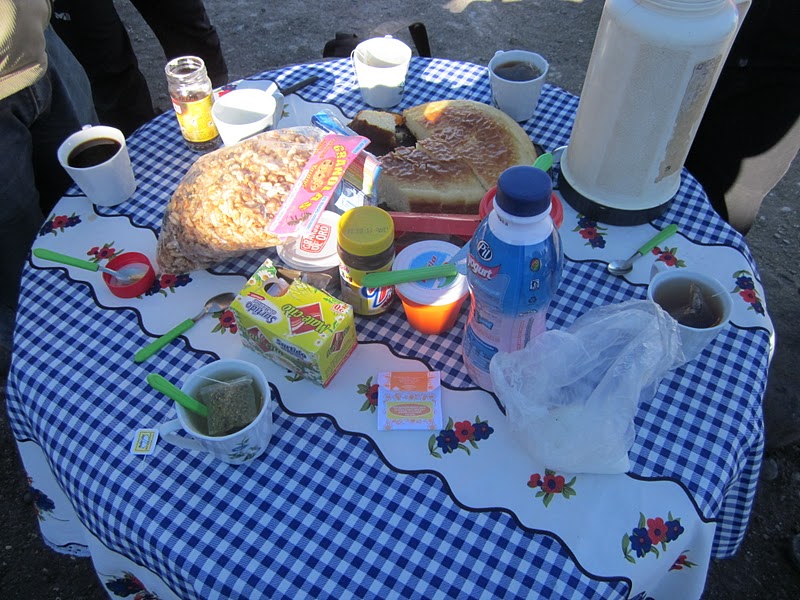
We then had a breakfast of sweet bread with manjar, jam, yogurt, and tea and coffee. While we were eating a pair of alpaca (llama like animals) walked by.
After that was the highlight of the tour. We drove out to the very middle of the salt flats to admire the beauty and take lots of awesome pictures. Our tour guide showed us that the salt flats can actually be drilled through, and that under them is water that crystallizes the other side of the ground.
The white ground and blue sky background makes for some amazing picture taking. You can use the blue backdrop to create some pretty cool optical illusions:
After about an hour and a half of taking any type of picture we could think of, we made our way to the salt mines. There they actaully dig up the salt and put it into huge piles. They are then later taken to a salt prcoessing plant, heated up, and treated with iodine before being bagged and sold. They can produce 50 kg of salt for about 13 bolivianos. So that´s about 110 pounds of salt for 2 bucks.
Our next stop was to a place I never even thought existed: a train cemetary. Apparently Bolivia puts its old trains into this area of the desert, and people coming through can visit and admire them. A lot of people also decide to leave their own calling card on them, as seen by all of the grafitti.
After this, we arrived in the town of Uyuni. I had to go to immigration to get my tourist visa, so the tour guide went with me. This ended up being a bit more problematic than I was expecting. First off, they told me that I couldn´t pay the $135 US dollar tourist visa fee in US dollars. I told them that I called up and they specifically told me that I could pay in dollars. Then after that they told me I needed a yellow fever vaccination. I told them that my tour never told me about it and that the customs officials at the border crossing never advised me about it, so I didn´t know how I could be held responsible for it. Despite that, they issued me a fine of 50 bolivianos (which is about 7 dollars). I told them that I didn´t have bolivianos, so they took it out of the change they owed me since I had 3 fifty dollar bills. I was a bit annoyed and felt like they took advantage of the situation, but in the end I got in and out of the country without a problem.
I then met up with the rest of the people on my tour. We left Uyuni at 5:45, and we were supposed to arrive at 9 at night. Note the key phrase "were supposed to". Around 8 it was already pitch black, and the truck´s battery died. This didn´t seem to phase anyone else, as it gave them the perfect opportunity for a smoke break. As we stood outside it was amazing seeing the night sky, as you can see all of the stars and constellations with the naked eye in San Pedro.
After about 20 minutes, the driver got the truck started. We boarded and continued on our way. Then half an hour the same thing happened again. After about 10 minutes he still didn´t have the truck working, and I seriously thought we were going to be stranded in the Bolivian desert for the night. (Keep in mind that we are in the middle of nowhere and without any cell phone reception). I knew that worrying about it wouldn´t change anything, so I simply continued resting.
Eventually it started again, and every once in a while the truck died again. The last time was in the middle of a river with water about a foot deep, but luckily our driver got it started again without getting out.
We finally arrived at about 10:45. I was too tired to take any pictures, but the accomodations were bare bones again. We were hungry for dinner and devoured some pasta with sausage and tomato sauce before turning in. The following morning we´d have to be up at 5 to be on the road by 5:30 so that we could make it back to San Pedro by 1 in the afternoon.
At this point the reality was sinking in that the trip was coming to a close. I felt sad that it was ending, but at the same time so happy that I finally made it to an area that I had wanted to see ever since I arrived in South America. Adding in the fact that I hadn´t showered or shaved for four days by the last day of the trip made me glad to be returning to San Pedro.
The second day of the tour started off with a visit to the Arboles de piedra, or stone trees. It´s literally a large field of stone in various formations that you can explore and climb. It´s in the desert and the terrain is reminiscent of the Grand Canyon. We found a few patches of snow, giving testament to the frigid temperatures we encountered the night before in the hostel.
Our next stop was at the lagunas antiplanicas, which were high altitude lagoons. The first one we visited reflected the mountains in the water as if it were a mirror.
Then the laguna honda, or round lagoon, had a lot of flamingos. After snapping some pictures we sat down for a picnic lunch of pastel de papas (potato cake) with tomatoes and cucumbers.
A short ride later we arrived at el volcan Ollague. We snacked on some lollipops while we explored the area and took pictures.
En route to our next night´s luxurious accomodations we crossed a railway tracks that connects Bolivia to Chile. As we all lay down on the tracks for a picture, our tour guide joked with us that a trains was coming from the opposite direction. We all fell for it.
Around 8 that night we arrived in our next night´s stay, which was a salt hotel. The word hotel is much of an overstatement, and I heard that it´s actually more accurately referred to as a refugio (or refuge). Yes, it´s pretty much what it sounds like: beds on slabs of stone, one light in each room that didn´t necessarily work all the time, as pretty much as bare bones as you can get.
The cool part of staying there was that everything was made of salt: the walls, the bases for the beds, and even the ground was grains of salt. Our dinner was a soup with bread followed by chicken and french fries and rice. We turned in pretty early, as we had to be up before sunrise on the salt flats.
The third day of the tour was the most amazing part. We woke up before sunrise and piled into the 4x4 to drive to the salt flats. Just to give you an idea as to how vast they are, they cover 12,000 square kilometers, or about 4600 squre miles. We arrived as the sun was rising, and it gave a really beautiful view of the mountains in the background.
After snapping a few pictures there, we went on to the Isla de las pescadores, or Fisherman´s Island. It isn´t an island as you would typically think of it, but if you think of the salt flats as a huge lake it would make sense. It is covered with lots of cacti and has amazing views of the salt flats and mountains. The climb up was a bit challenging and you had to be careful with your footing, but once you made it to the top it was worth the trip.
Somehow on the way down I didn´t see the path continue, and so I figured I had to go back the same way I came. I went off the marked path a few times since the arrows were coming from the opposite directions, but after seeing the steep inclines I made my way back on track. I was a bit annoyed at myself for not waiting for the group, but as I was on my way back I noticed something: vizcacahas!
Vizcachas are animals that are native to Peru and Bolivia (and maybe a few other countries too). They´re a hybrid between a rabbit and a squirrel, with the main body of the rabbit but the tail of a squirrel. So in the end my detour was worth it.
We then had a breakfast of sweet bread with manjar, jam, yogurt, and tea and coffee. While we were eating a pair of alpaca (llama like animals) walked by.
The white ground and blue sky background makes for some amazing picture taking. You can use the blue backdrop to create some pretty cool optical illusions:
After about an hour and a half of taking any type of picture we could think of, we made our way to the salt mines. There they actaully dig up the salt and put it into huge piles. They are then later taken to a salt prcoessing plant, heated up, and treated with iodine before being bagged and sold. They can produce 50 kg of salt for about 13 bolivianos. So that´s about 110 pounds of salt for 2 bucks.
Outside the salt plant there were artisans selling a lot of goods, and so I got some alpaca scarves and other souveniers for a good price. Unfortunately I didn´t have enough bolivianos on me, but they accepted Chilean pesos for a bit of a higher price.
As we continued on, we stopped for lunch at an area where we saw some deer crossing. Lunch was basic but filling: tuna fish, rice, and tomatoes and corn.
After this, we arrived in the town of Uyuni. I had to go to immigration to get my tourist visa, so the tour guide went with me. This ended up being a bit more problematic than I was expecting. First off, they told me that I couldn´t pay the $135 US dollar tourist visa fee in US dollars. I told them that I called up and they specifically told me that I could pay in dollars. Then after that they told me I needed a yellow fever vaccination. I told them that my tour never told me about it and that the customs officials at the border crossing never advised me about it, so I didn´t know how I could be held responsible for it. Despite that, they issued me a fine of 50 bolivianos (which is about 7 dollars). I told them that I didn´t have bolivianos, so they took it out of the change they owed me since I had 3 fifty dollar bills. I was a bit annoyed and felt like they took advantage of the situation, but in the end I got in and out of the country without a problem.
I then met up with the rest of the people on my tour. We left Uyuni at 5:45, and we were supposed to arrive at 9 at night. Note the key phrase "were supposed to". Around 8 it was already pitch black, and the truck´s battery died. This didn´t seem to phase anyone else, as it gave them the perfect opportunity for a smoke break. As we stood outside it was amazing seeing the night sky, as you can see all of the stars and constellations with the naked eye in San Pedro.
After about 20 minutes, the driver got the truck started. We boarded and continued on our way. Then half an hour the same thing happened again. After about 10 minutes he still didn´t have the truck working, and I seriously thought we were going to be stranded in the Bolivian desert for the night. (Keep in mind that we are in the middle of nowhere and without any cell phone reception). I knew that worrying about it wouldn´t change anything, so I simply continued resting.
Eventually it started again, and every once in a while the truck died again. The last time was in the middle of a river with water about a foot deep, but luckily our driver got it started again without getting out.
We finally arrived at about 10:45. I was too tired to take any pictures, but the accomodations were bare bones again. We were hungry for dinner and devoured some pasta with sausage and tomato sauce before turning in. The following morning we´d have to be up at 5 to be on the road by 5:30 so that we could make it back to San Pedro by 1 in the afternoon.
At this point the reality was sinking in that the trip was coming to a close. I felt sad that it was ending, but at the same time so happy that I finally made it to an area that I had wanted to see ever since I arrived in South America. Adding in the fact that I hadn´t showered or shaved for four days by the last day of the trip made me glad to be returning to San Pedro.
Subscribe to:
Posts (Atom)